Five Empires. One Threshold.
The story of Binat Bibi Masjid is the story of Bengal told in compressed form — from the rise of an independent Sultanate to the rise of an independent republic. Below, that story, in eight chapters.
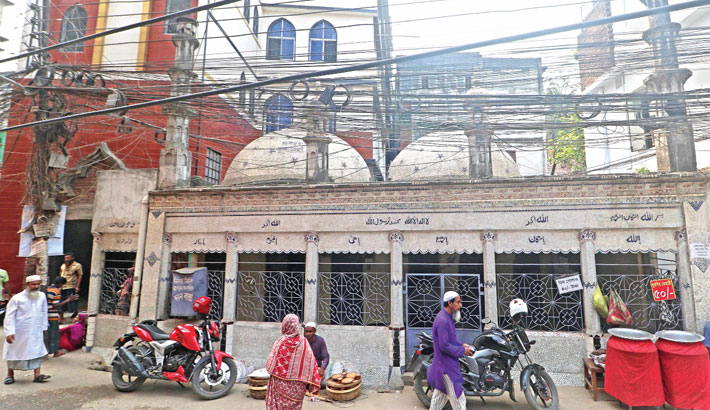
The story of Binat Bibi Masjid is the story of Bengal told in compressed form — from the rise of an independent Sultanate to the rise of an independent republic. Below, that story, in eight chapters.
Fakhruddin Mubarak Shah declares independence from Delhi at Sonargaon, founding what will become a sovereign Bengal — culturally Persian, climatically delta, materially brick. The political ground for Binat Bibi Masjid is laid more than a century before its first stone.
The Ilyas Shahi dynasty returns to power. The reign of Sultan Nasiruddin Mahmud Shah — described in chronicles as a builder-king — sees a wave of mosque construction across the delta, much of it patronised not by the throne but by merchants, governors and pious women of standing.
Bakht Binat, daughter of Marhamat, completes the construction of a small congregational mosque in Narinda. A Persian inscription is set into the wall above the central mihrab, recording the year as 861 AH — establishing this building, today, as the earliest dated Islamic structure of Dhaka and a foundational document of the city's pre-Mughal Muslim presence.
Akbar's general Munim Khan defeats the Karrani Sultan; Bengal becomes a Mughal subah. By 1610 Dhaka itself is the provincial capital. The mosque, by then more than 150 years old, is folded into a city expanding rapidly around it. New, larger mosques are built — but Binat Bibi remains a quiet local landmark, kept in use by the residents of Narinda.
From the Battle of Plassey to the formal end of Company rule, Dhaka declines from imperial capital to provincial town. Many older monuments fall into decay. Binat Bibi Masjid is reported in nineteenth-century gazetteers as still in worship-use — small, structurally intact, surrounded by the encroaching grain markets and tanneries of a changed riverside neighbourhood.
Colonial-era surveyors of Indian antiquities formally photograph and measure the mosque. Inscription readings published during this period preserve, for the first time, the mosque's full Persian text in printed form — work which underpins almost every later study, including this one.
The mosque passes through two political births — the partition of British India and, twenty-four years later, the liberation of Bangladesh. Its register of worshippers shifts in language and accent; its qibla wall does not. Local stewardship intensifies as the mosque becomes a small but strong neighbourhood symbol.
The mosque is added to heritage registers and gains formal protected-monument status. New annexes accommodate growing congregations, while the original 15th-century chamber — its dome, mihrab and inscription tablet — is conserved as the documentary core. The challenge of the present century is balance: a working mosque inside a primary historical document.
Most pre-Mughal mosques in Bengal are dated only by inference — by their bricks, their dome profiles, their stylistic affinities. Binat Bibi Masjid is dated by itself. The Persian inscription above the mihrab gives a name, a parentage, a sultan and a year. It transforms the building from an example of a type into a specific historical event, locatable on a map and on a calendar. Without that single tablet, we would have a mosque. With it, we have a moment in 1457.
See How It Was Built→